Motorcycle Safety
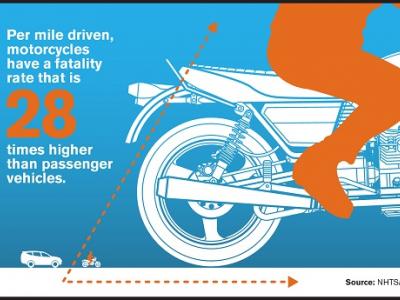
Motorcyclists fatalities have steadily increased over the past decade. In fact, in 2007, there was a seven percent increase in fatalities from 4,837 in 2006, to 5,154. Per vehicle mile traveled in 2007, motorcyclists were about 37 times more likely than passenger car occupants to die in a motor vehicle traffic crash and nine times more likely to be injured.
Recent National Highway Traffic Safety Administration (NHTSA) data provides statistics on motorcycle use and safety trends in the United States:
-
Helmet Use
Learn More About Motorcycle Safety
Survey of the States: Motorcycle Safety Programs
Published 2008
In the past five years, motorcycle helmet use has been increasing slowly but steadily – increased from 48 percent in 2005 to 67 percent in 2009. NHTSA estimates that helmets saved the lives of 1,829 motorcyclists in 2008. If all motorcyclists had worn helmets, an additional 823 lives could have been saved. - Licensing Issues
One out of four motorcycle riders (25%) involved in fatal crashes in 2008 were riding their vehicles with invalid licenses at the time of the collision, while only 12 percent of drivers of passenger vehicles in fatal crashes did not have valid licenses. - Impaired Riding
In 2008, 30 percent of all fatally injured motorcycle riders had BAC levels of
.08 g/dL or higher. Forty-three percent of motorcycle riders who died in single-vehicle crashes had BAC levels of .08 or higher. - Speeding
In 2008, 35 percent of all motorcycle riders involved in fatal crashes were speeding, compared to 23 percent for passenger car drivers, 19 percent for light-truck drivers, and 8 percent for large-truck drivers.
States can use this type of information to help them find the right mix of rider education, enforcement and laws to decrease deaths and injuries resulting from motorcycle crashes. Current state approaches to address motorycle safety include:
- Mandatory rider education courses
- Special endorsements on driver licenses
- Reducing the number of impaired motorcyclists
- Increasing motorist awareness of motorcycles
- Increasing helmet use through education and/or legislation
GHSA Policy
Excerpted from GHSA's Highway Safety Policies & Priorities
[115 KB, 27 pgs.]
H. Motorcycle Safety
Motorcyclists are over-represented in traffic crashes and, coupled with the greater vulnerability of the motorcyclist, this represents a serious highway safety problem. Hence, GHSA encourages funding for development, implementation, and evaluation of statewide comprehensive motorcycle safety programs. At a minimum, these programs should address rider training, protective gear use, impaired riding, operator licensing, motorist awareness and conspicuity.
H.1 Motorcycle Helmet Laws
GHSA urges states to support the use of DOT-certified helmets by motorcycle riders of all ages, oppose efforts to repeal their universal motorcycle helmet laws and adopt motorcycle helmet laws for all riders. States should vigorously enforce their motorcycle helmet laws to ensure that motorcyclists are not using helmets that do not meet DOT standards.
H.2 Motorcycle Operator Training
All states should require motorcycle operator training for minors, novice, and re-entry riders by qualified instructors.
NHTSA, along with motorcycle organizations and other stakeholders, should develop a model motorcycle operator training program and quality control guidelines for instructors, deploy them at selected locations and then evaluate their effectiveness. Once the model curricula and instructor guidelines are complete, then states are encouraged to use them. States should also examine their motorcycle crash data to determine if the model training program should address specific state problems by emphasizing certain situations or skills. States should be encouraged to enhance their training to ensure that state-specific needs are met.
H.3 Impaired Motorcycle Programs
Impaired motorcyclists are a substantial proportion of total motorcycle fatalities and injuries. States should develop and implement programs for the impaired motorcyclist that include enforcement, sanctions (including fines and vehicle sanctions), and publicity about the enforcement effort. States are also encouraged to develop, deploy and evaluate other initiatives that discourage drinking and riding.
H.4 Licensing of Motorcyclists
All states should require motorcyclists to obtain a motorcycle operator license and endorsement before they ride on a public highway. In order to obtain the license, motorcycle operators should be required to pass knowledge, skills and vision tests unless the motorcyclist can demonstrate that he/she has completed a state-approved operator training program. States should actively enforce their motorcycle operator licensing laws.
NHTSA, along with motorcycle organizations and other stakeholders, should develop a model motorcycle operator licensing and testing program that includes graduated licensing for motorcyclists. NHTSA should ensure that this program measures the minimum skills and knowledge needed for safe riding and should evaluate its potential impact on crashes, fatalities and injuries. Once completed, states should be encouraged to implement the model program statewide, periodically evaluate its effectiveness, and modify the program as necessary.
H.5 Motorcycle Awareness Programs
States should undertake awareness programs to promote motorcycle helmet use, publicize state motorcycling licensing laws, discourage impaired riding, and encourage the use of protective and conspicuous clothing as well as increased conspicuity of the motorcycle. Additionally, states should undertake public information campaigns to raise motorists’ awareness about sharing the road with motorcycles and should ensure that novice driver education and training courses include instruction on sharing the road with motorcycles.
H.6 Motorcycle Research
NHTSA should conduct a study on the causes of motorcycle crashes so that effective countermeasures can be developed and implemented.