Occupant Protection
Occupant protection refers to safety features designed to protect occupants of motor vehicles in the event of a crash. These systems can be 'active' or 'passive.' Active devices provide protection only if the user performs some specific act, such as fastening a seat belt. Passive devices, such as airbags, require no action on the part of the occupant.
GHSA is committed to keeping drivers and passengers safe through appropriate occupant protection use.
Seat Belts
Learn More About Occupant Protection
State Laws
Seat Belts
Child Passenger Safety
Occupant Protection for Children Best Practices
Published 2008
Seat belts are the oldest form of occupant protection, with Volvo patenting the first rudimentary seat belt in 1889. However, it wasn't until 1968 that the federal government required seat belts to be installed in all new passenger cars.
State Laws
New York enacted the first state seat belt law in 1985. Over time other states followed suit and began passing their own laws. These laws can be broken down into two categories:
- Primary
Primary seat belt laws allow law enforcement to stop a vehicle and issue a citation when the officer observes an unbelted driver or passenger. - Secondary
Secondary seat belt laws allow law enforcement to stop a vehicle and issue a citation only after the officer cites the offender for another violation, such as speeding.
GHSA strongly encourages all states to adopt and enforce primary seat belt laws. Today, the trend is moving in this direction, as 32 states, the District of Columbia, American Samoa, Guam, the Northern Mariana Islands, Puerto Rico, and the Virgin Islands have primary seat belt laws.
Click It or Ticket
Click It or Ticket is a national program to boost seat belt use and reduce highway fatalities through stepped up enforcement of seat belt laws, augmented by national and state media campaigns. It takes place each year around Memorial Day. Recent campaigns have focused on nighttime seat belt use because fewer people buckle up at night.
GHSA's State Highway Safety Office (SHSO) members provide funding for increased enforcement and work with law enforcement agencies and other partners to spread the word about the importance of seat belt use.
Seat Belt Use Rates
Seat belt use rates have steadily increased over time. In 1994, the overall observed seat belt use rate was 58 percent. By 2010, the national average was 85 percent. Many factors have contributed to the increase in seat belt use, including:
- Changing Secondary Laws to Primary Enforcement
Many states originally enacted seat belt laws with secondary enforcement, and later amended those laws to primary enforcement. - Upgrading Seating Positions Affected
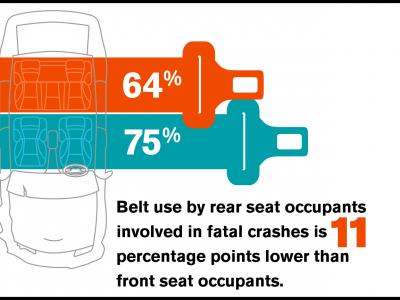
Some laws applied only to front-seat occupants, but many have been changed to include rear occupants as well. - Increased Fines
Higher fines are associated with higher use rates. - Seat Belt Reminders in Vehicles
More vehicles are being equipped with seat belt reminders, which have been found to be effective, especially with part-time seat belt users. - Addressing Racial Profiling Concerns
As more and more states have enacted primary belt laws without any evidence of differential enforcement, concerns by minority groups have diminished. - Education
Education helps the public understand how seat belts save lives and reduce injuries. As a result, more people are willing buckle up, regardless of the law.
Child Passenger Safety
The first car seats were invented in 1921, following the introduction of Ford's Model T. The earliest versions were essentially sacks with a drawstring attached to the back seat.
Seat Belts & School Buses
The federal government is re-examining whether children should be buckled up when they ride in a school bus.
Currently, six states – California, Florida, Louisiana, New Jersey, New York, and Texas – have seat belt requirements for school buses.
GHSA News Release (Jan. 1, 2008)
Legislation
In 1971, the federal government established minimum standards for child safety seats and restraint systems to reduce the number of children killed or injured in motor vehicle crashes. Today all states and territories have child passenger safety laws, although requirements of the laws vary widely.
Traffic safety groups agree that a strong child passenger safety law should:
- Cover all children up to age 16 in all seating positions
- Be primary enforcement
- Require all children to be in age- and size-appropriate restraint systems (infant, child safety seat, booster seat)
- Require children younger than 13 to be properly secured in rear seats (provided the vehicle has them), unless all available rear seats are in use by children younger than 13
- Apply to all vehicles equipped with seat belts; no vehicles (such as pickup trucks, taxis, or rental cars) should be exempt
- Make the driver responsible for restraint use by children under 16, regardless of the relationship to the child
- Allow passengers to ride only in seating areas equipped with seat belts and prohibit passengers in the cargo areas of pickup trucks
- Assure children with special needs use proper restraints
- Contain no exemptions, such as: allowing children to be unsecured if all seat belts are in use; attending to the personal needs of the child; medical waivers; out-of-state vehicles; and or drivers who are not the vehicle owner or who are not related to the child
Law Enforcement Materials
To help police officers provide parents with the most up-to-date child passenger safety information for their state, Children's Hospital of Philadelphia (CHOP) partnered with GHSA to provide some great resources for State Highway Safety Offices and their law enforcement grantees.
Air Bags
Air bags supplement the seat belt by reducing the chance that the occupant's head and upper body will strike some part of the vehicle's interior. They also help reduce the risk of serious injury by distributing crash forces more evenly across the occupant's body.
Although there have been air bag-like devices for airplanes since the 1940s, air bags for automobiles were not introduced until 1971 as an experimental option, becoming available for general sale to the public in 1973. Since 1998, driver and passenger air bags have been mandatory equipment in all passenger cars. Requirements for light trucks and vans followed in 1999. Now, side-impact air bags are being installed in more models.
According to data analysis by the National Highway Traffic Safety Administration (NHTSA) and the Insurance Institute for Highway Safety (IIHS), air bags, when combined with lap-shoulder seat belts, reduce driver and passenger fatalities by nearly 50 percent.
GHSA Policy
Excerpted from GHSA's Highway Safety Policies & Priorities
[115 KB, 27 pgs.]
D. Occupant Protection
As a behavioral factor affecting highway safety, occupant protection is a priority focus of the Association. Issues that fall into this category include, but are not limited to, safety belts, child restraint systems and air bags.
D.1 Mandatory Safety Belt Use Laws and Belt Use Policies
GHSA strongly encourages all states to adopt and enforce primary safety belt use laws that apply to all occupants in all seating positions.
All states are encouraged to continue their high visibility enforcement of safety belt laws and to conduct sustained occupant protection enforcement efforts. In addition, states should undertake nighttime enforcement campaigns since nighttime belt usage is typically lower than daytime usage.
In many, if not most states, the safety belt usage rate is such that only the most resistant person is unbuckled. These remaining holdouts require stronger measures. Consequently, GHSA encourages states to consider the assignment of drivers’ license penalty points and/or increased fines for safety belt violations. GHSA also encourages states to conduct targeted education and enforcement campaigns for high risk populations such as teens and rural populations.
GHSA urges all state highway safety offices (SHSO) require that entities contracting with the SHSO’s to initiate and maintain a mandatory safety belt use policy for that entity. This would include state and local governments, nonprofits and others.
GHSA encourages motor vehicle manufacturers to install safety belt reminder systems in all new vehicles to encourage the use of safety belts, particularly by part-time users. Additionally, GHSA urges Congress to amend current law so that manufacturers can install reminder systems without conflicting with statutory prohibitions against such systems.
D.2 Adjustable Upper Anchorages
GHSA urges manufacturers to install adjustable upper anchorages in all new model vehicles because misuse of safety belts is a frequent problem that reduces the effectiveness of these lifesaving devices, particularly for older children and short stature adults.
D.3 Child Restraints
GHSA urges the promotion of the proper use of child passenger protection systems; endorses child restraint clinics, fitting stations, other educational programs; and endorses education and awareness regarding the proper maintenance of restraints.
GHSA recommends that the motor vehicle manufacturing industry and NHTSA take additional steps to reconcile existing problems of compatibility between child restraints and the vehicles and vehicle restraint systems with which the seats are to be used. GHSA encourages these parties to maintain a close collaboration in order to prevent incompatibility problems from arising in the future.
D.4 Occupant Protection for Children
Many state child restraint laws contain gaps in coverage or provide exemptions that allow children to go unrestrained in certain circumstances. GHSA supports the closing of these gaps and urges states to enact laws that cover every child in every seating position for all vehicles.
GHSA supports the policy that rear-facing infants should never be placed in the front seat of passenger side air bag equipped motor vehicles (unless the vehicle has no rear seat but has an air bag shut-off switch.) NHTSA and GHSA members are encouraged to undertake educational campaigns to inform parents of the dangers of putting infants and young children in the front seat.
GHSA strongly concurs that children 12 years old and under, particularly those riding in vehicles with passenger side air bags, should be encouraged to sit in the rear seat of motor vehicles. In order to increase restraint use by older children, GHSA supports research and development of restraint systems for children up to and including those 12 years of age or those above 65 lbs.
Based on currently available research, GHSA believes that compartmentalization provides adequate pupil protection on school buses. GHSA does not endorse the use of three-point belts on older buses unless and until further analysis demonstrates the injury-reducing potential, cost-effectiveness and value of such an addition.
GHSA encourages states to enact booster seat legislation in order to protect young children who are too large to be placed in child restraints.
GHSA endorses the LATCH (Lower Anchors and Tethers for Children) requirements and urges states to undertake educational programs explaining how LATCH-equipped child restraints should be used with LATCH-equipped vehicles.
GHSA encourages states to conduct assessments of their Occupant Protection for Children programs in order to ensure that they are using their federal resources strategically and in a way that meets needs.
D.5 Air Bags
GHSA urges NHTSA to test the efficacy of air bags using crash dummies of various sizes, belted and unbelted, in various positions at various speeds in order to duplicate real world crash experiences to the greatest practicable extent. GHSA further urges auto manufacturers, under the guidance of NHTSA, to develop, test and offer expeditiously advanced air bag technology that protects all-sized occupants in new model vehicles.
GHSA supports deactivation of air bags only under controlled circumstances (such as for medical conditions) in which NHTSA makes the final approval on deactivation requests in accordance with the federal regulations of November 21, 1997. GHSA also recommends establishing a registry with deactivation approval that customers of used vehicles could consult prior to purchase.
D.6 Federal Occupant Protection Training Programs
GHSA supports and encourages the certification and adoption of NHTSA’s current occupant protection curriculum by the states and the inclusion of the curriculum or its equivalent in the required training for police recruits and for the in-service training of officers. Furthermore, GHSA supports holding regional or state police fleet safety workshops in those areas where additional commitment to occupant protection on the part of law enforcement executives would be desirable.
D.7 Pickup Trucks
Ejection from the cargo space of pickup trucks accounts for needless highway safety injuries and deaths, particularly of children and teenagers. GHSA strongly encourages all states and territories to adopt and enforce laws prohibiting all passengers from riding in the cargo areas of pickup trucks.