Summary
Across Missouri, many elementary students, especially in rural communities, have limited opportunities to walk, bike, or roll safely in their neighborhoods or to school. Smaller school enrollments, limited infrastructure and fewer local programs can reduce students’ access to hands-on traffic safety learning.
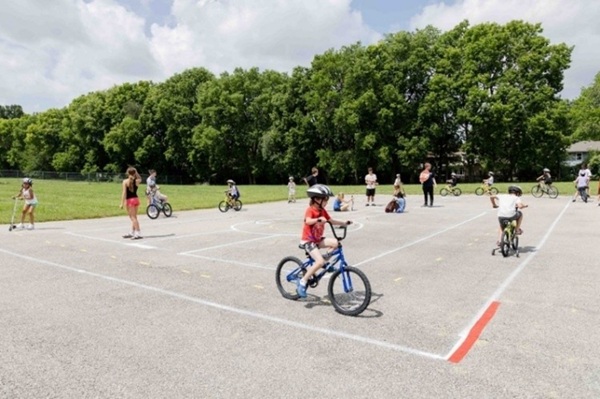
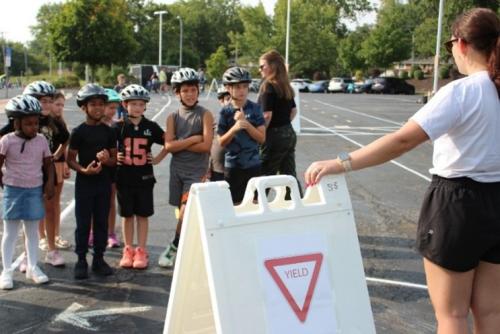
To address this gap, MODOT leveraged its seven regional Missouri Coalition for Roadway Safety (MCRS) chapters to deliver traffic gardens. A traffic garden is a miniature street network designed for children to practice biking and road safety in a safe, car-free environment. It includes features like small roads, intersections, and traffic signs to help teach the rules of the road. Biking and road safety in a safe, car-free environment. It includes features like small roads, intersections, and traffic signs to help teach the rules of the road. Schools were selected based on MODOT’s high-priority school list, coalition relationships, school readiness and site suitability. This approach enabled hands-on, personalized program delivery to communities where students often lack regular exposure to active transportation environments.
Traffic Garden Events
Over the course of the project, MODOT and partners conducted nine traffic garden events at seven elementary schools statewide. Events were primarily hosted in rural or high-priority communities where class sizes are smaller and students often have limited opportunities to walk, bike, or roll in their neighborhoods. This included traffic garden events at Orchard Drive Elementary in Jackson, Kentucky Trail Elementary in Belton, Barry and Pathfinder Elementary Schools in Kansas City and Hurricane Deck Elementary in Sunrise Beach.
Across the grant period, the traffic gardens reached 506 elementary students with hands-on bicycling and pedestrian safety practice paired with classroom instruction.
Across collected assessments, average quiz scores increased from about 65% pre-event to about 77% post-event, showing hands-on traffic gardens reinforced classroom instruction. These surveys and the live observations and feedback the project team received from students, volunteers and teachers showed significant improvement and enthusiasm among participating students, indicating this model can produce reliable knowledge gains when assessment participation is strong.
Project Impact
The project demonstrated measurable learning gains through combined classroom instruction and hands-on practice. Students didn’t just hear about traffic safety, they practiced it, building real-world skills like pre-ride safety checks, bike-riding awareness and confident decision-making on the road.
One of the most important outcomes was the spread of the traffic garden concept beyond grant-funded sites. At least two schools (Lafayette County Elementary School and Gladstone Elementary) hosted traffic garden events independently after using the project guide and observing grant-supported events. Additional interest came from youth-led traffic safety teams, local hospitals and a Kansas City bike and pedestrian advocacy nonprofit. Not all inquiries led to immediate events, but they signal growing statewide interest and future potential.